Key takeaways
- A Business Profile for a service-area business can list up to 20 service areas by city, postal code or other area.
- FMCSA says companies whose commercial vehicles haul cargo between states must be registered and have a USDOT number.
- Under a Personally Procured Move, a service member can hire a commercial mover and is paid 100% of the government's estimated cost of the move.
- Google Local Services Ads are available only for certain categories, and moving services is one of them.
A moving company’s target market is the group of customers most likely to book the moves you do best and earn the most on, and for most movers it breaks into a handful of segments: local residential moves, long-distance moves, commercial and office moves, and specialty groups such as seniors who are downsizing, military families on PCS orders, students and employees on corporate relocations. You find yours by looking at the jobs you have already booked, checking which segments your crews, trucks and licenses can actually serve, and then reaching each chosen segment with the searches, pages and ads that match how it looks for a mover.
The main customer segments for a moving company
Most movers serve several of these groups at once, but each one searches differently and checks different things before it calls, so use this worksheet to mark the segments that fit your company and plan for each one separately.
| Segment | Who they are | How they tend to search | What they need to see before booking |
|---|---|---|---|
| Local residential | Renters and homeowners moving within the same metro area | “movers near me”, “apartment movers [city]”, “2 bedroom move cost” | A clear rate, recent reviews from nearby customers and availability on their date |
| Long-distance and interstate | Households moving to another state | “long distance movers [city]”, “movers from [city] to [city]” | Federal registration, a written estimate and how delivery dates work |
| Commercial and office | Businesses moving an office, store or warehouse | “office movers [city]”, “commercial moving company” | Evening or weekend moves, insurance certificates and one project contact |
| Seniors and downsizing | Older adults moving to a smaller home or senior living, often with family helping | “senior movers [city]”, “downsizing help” | Patience, full packing and unpacking, and help deciding what to keep, sell or donate |
| Military PCS | Service members and families moving to a new duty station | “military movers [base]”, “PPM movers” | Experience with military moves and the paperwork a family needs for reimbursement |
| Students | College students moving in and out of dorms and apartments | “student movers [college town]”, “summer storage and moving” | Low minimums, short jobs, storage and dates around move-in and move-out |
| Corporate relocation | Employees moving for a job, often with the employer paying | “corporate relocation movers”, supplier lists | Invoicing to a company, consistent service across many moves and simple reporting |
| Specialty items | Owners of pianos, safes, art, antiques or gym equipment | “piano movers [city]”, “safe movers” | The right equipment, proof of experience and suitable insurance |
The searches show how each group tends to phrase its need, with no volumes implied, and the exact wording in your area will appear in your Google Ads search terms report and in Search Console. Our guide to finding long-tail keywords shows how to collect these specific phrases.
How to work out which segments fit your company
The best evidence of who your market is sits in the jobs you have already booked, so start with your own records before you look at anybody else’s.
- Pull the last 12 months of booked jobs into a spreadsheet and tag each one by move type, distance, size (studio, two bedroom, office), revenue and where the lead came from.
- Work out revenue per crew hour or per truck day for each segment, because a segment with fewer but larger jobs can be worth more than one with many small ones.
- Check what you are licensed and equipped to do. Moves across state lines bring federal rules, since the FMCSA says companies whose commercial vehicles haul cargo between states must register and have a USDOT number.
- Look at your calendar. Residential moves tend to bunch up in summer and around the end of the month when leases turn over, while offices often want weekend moves, so segments that fill each other’s quiet weeks keep crews busy all year.
- Search each segment’s phrases in your area and note who shows in the map results and ads, since a segment where few local movers have a dedicated page is easier to win.
- Write one sentence that defines each segment you pick, for example “two to four bedroom homes moving within 50 miles of our yard”, so your ads, pages and the person answering the phone are all aiming at the same customer.
Local and long-distance customers need different marketing
Local residential customers usually search close to their move date and call the first few movers that look trustworthy, so they are won in the Google map results and with ads aimed at your service area. Google lets a service-area business list up to 20 service areas by city or postal code (Google Business Profile Help), so set those to the places you actually want jobs from, and keep the profile current with our guide to editing your Google Business Profile.
Long-distance customers compare quotes over a longer stretch and are often searching from somewhere other than where the move starts. Google Ads can show ads to people who have shown interest in a location, for example through searches that name a place, even when they are physically somewhere else (Google Ads Help). These customers also check whether a mover is legitimate, and FMCSA keeps a registered mover database on its Protect Your Move page and says movers must give customers the “Your Rights and Responsibilities When You Move” booklet before an interstate move, so show your USDOT number and link that booklet on your long-distance page.
Specialty segments worth a closer look
Military families on PCS orders
When the Defense Secretary set up a new office for military household goods moves in 2026, he put the number of service members who move every year at more than 300,000 (MOAA). Many of those moves are arranged through the government, but a Personally Procured Move lets the service member organize the move, including hiring a commercial moving company, and be paid 100% of what the government estimates the move would have cost it (Personal Property Activity). If you are near a base, a page written for PPM families that shows your FMCSA registration speaks directly to them.
Seniors and downsizing
Senior moves involve more sorting and packing and are often planned with an adult son or daughter who may be the one searching, so speak to both. The National Association of Senior and Specialty Move Managers lists move managers who help older adults declutter, downsize and relocate, and those managers need reliable movers, which makes them a referral source as much as a competitor.
Students
Student moves are small, cluster around the start and end of each term and pair well with storage, so they suit a mover near a campus that can fill those weekends without turning away larger jobs.
Commercial and corporate relocation
Office moves are usually won through a walkthrough and a proposal for an office or facilities manager, while corporate relocation work tends to come through employers and relocation companies with approved supplier lists, and both reward a mover that shows insurance, references and a named project contact.
How to reach each segment through search and ads
Once you have picked your segments, give each one its own landing page with its own quote form, its own ad group in Google Ads, and reviews or photos from that kind of job, because a senior downsizing page and an office move page answer different worries. Our guide to building PPC landing pages covers what each page needs to turn a click into a quote request.
Google’s Local Services Ads, the pay-per-lead listings that sit at the top of some searches, are available only for certain service categories, and moving services is one of them (Local Services Help), so most residential movers should test them alongside regular search ads. Track every call and form by source to see which segment and channel books moves.
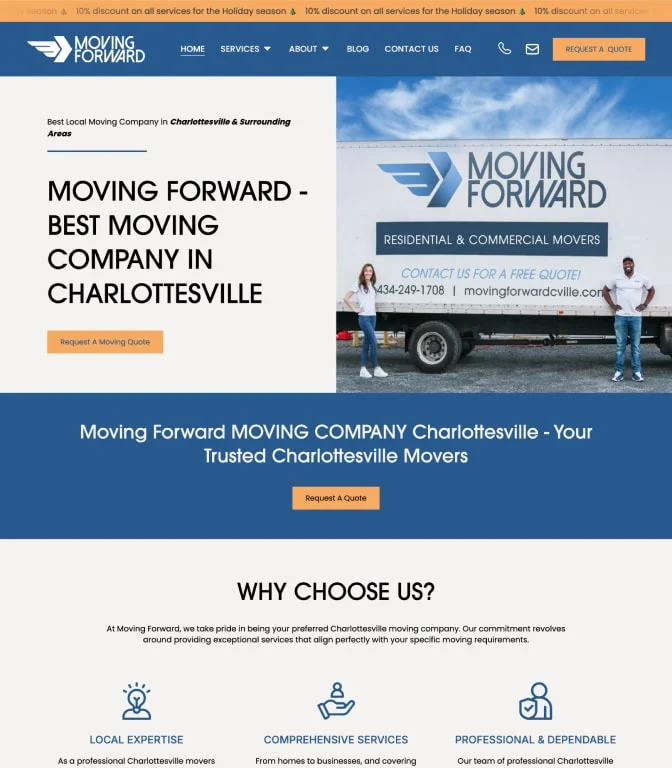
This is how we approach growth for movers, with ads, Google Maps and AI search run as one program and judged on booked moves, and it is the work behind 6,000+ inquiries for a Virginia moving company that we wrote up in our Moving Forward case study. Offline channels such as realtor and apartment partnerships still matter for some segments, and we collected those in our list of creative marketing ideas for moving companies.
Questions movers ask us
Should a new moving company focus on residential or commercial moves?
A new moving company usually does better starting with local residential moves, because those customers search online close to their move date, book quickly and leave reviews that build the Google profile every other segment depends on. Commercial work usually needs references first, so it makes a better second segment.
What is the most profitable type of move for a moving company?
The most profitable type of move for a moving company is the one that earns the most revenue per crew hour after fuel, labor and lead costs, and that differs from one company to the next. Work it out from your own job records, because a busy segment that ties up two crews all day can earn less than fewer, larger jobs.
How do moving companies get customers online?
Moving companies get most online customers through Google, from the map results driven by their Business Profile and reviews, from search ads and Local Services Ads, and from service pages that rank for searches such as “movers near me” or “long distance movers [city]”.
Does a moving company need a USDOT number to advertise long-distance moves?
A moving company that hauls household goods between states with commercial vehicles needs to be registered with the FMCSA and have a USDOT number, according to FMCSA’s registration guidance. FMCSA and the military’s moving office both point customers to that registration, so showing your number on your long-distance pages also helps people trust you enough to call.
Are Local Services Ads worth it for a moving company?
Local Services Ads are worth testing for a residential moving company, because moving services is one of the categories Google supports and you pay for leads rather than clicks. They work best when someone answers calls and messages quickly, since Google says ad ranking can suffer if a business regularly fails to respond.
How can a moving company get military moving customers?
A moving company can reach military customers by building a page for families doing a Personally Procured Move near the bases it serves, showing its FMCSA registration clearly, and running ads on searches that name the base. Families on PPM moves can hire a commercial mover themselves, so a clear quote and fast reply matter more than discounts.
How narrow should a moving company’s target market be?
A moving company’s target market should be narrow enough that you can describe each segment in one sentence and write a page that speaks only to it, and broad enough to keep crews busy through the slow months. For most local movers that means two to four segments, chosen from their own booking data rather than guesses.
If you want to see how your moving company’s website shows up in Google and AI search today, run our free SEO audit, and read how we help movers book more jobs on our marketing for moving companies and Google Ads management pages.
Free SEO audit
Want to know where your site stands?
Get a free score for SEO, speed and AI search, plus your top 3 fixes, in about a minute.
Keep reading

Search Engine Marketing
What Are the 4Ps of Healthcare Marketing?
The 4Ps of healthcare marketing are product, price, place and promotion. Here is what each means for a clinic, with…
7 min read

Marketing
What Is an Organic Marketing Strategy and How Do You Build One?
What organic marketing is, how it compares with paid ads, and the six steps we use to build an organic…
8 min read

Marketing
E-commerce Growth Hacking: 22 Strategies to Get More Sales From Your Store
22 e-commerce growth hacking strategies grouped by goal: getting found, converting visitors, raising order value and bringing customers back, with…
8 min read