Key takeaways
- Advertising pays a platform to show your message, while content marketing earns visits by publishing content people search for and choose to read.
- On Google Ads a month is never charged more than 30.4 times the average daily budget, so a $10 daily budget caps out at $304.
- The FTC says native ads must be clearly identifiable as ads, with labels such as "Ad" placed in front of or above the headline.
- Google asks for paid links in sponsored content to carry the rel="sponsored" attribute, so sponsored articles do not build rankings.
The difference between content marketing and advertising comes down to how people find you: advertising pays a platform to put your message in front of people, while content marketing earns attention by publishing something useful that people search for, read and share on their own. Advertising works the day you turn it on and stops the day you stop paying, whereas content takes months to build up but keeps bringing in visitors long after it is published. Most businesses that grow steadily use both, with ads bringing in customers now and content lowering what each customer costs over time.

What content marketing is
The Content Marketing Institute defines content marketing as a strategic approach focused on creating and distributing valuable, relevant and consistent content to attract and retain a clearly defined audience, and ultimately to drive profitable customer action (Content Marketing Institute). In practice that means blog posts, guides, videos, case studies, newsletters, podcasts and social posts that answer the questions your customers already have.
The content usually lives on channels you own, such as your website, your email list or your YouTube channel, so nobody can switch it off and every visit costs you nothing extra once the piece is made. The trade-off is time, because a new article can take months to rank, and only the pieces that genuinely answer a search better than the pages already ranking will bring in steady traffic. Content is the core of an organic approach, which our guide to building an organic marketing strategy lays out in six steps.
What advertising is
Advertising is any message you pay a platform to place, such as Google search ads, Meta ads on Facebook and Instagram, YouTube pre-roll, display banners, TV, radio, podcast reads or billboards. You decide who sees it, where and when, and you pay for that reach directly. Nonprofits sometimes get the space donated instead, which we cover in our post on what charity advertising means.
On Google Ads you set a maximum cost per click, which is the most you are willing to pay for a click, and you often pay less than that (Google Ads Help). Google treats your daily budget as an average, so a single day can spend up to twice the daily budget, but a month will not be charged more than 30.4 times it, which means a $10 daily budget caps out at $304 for the month. When the budget ends, the clicks end with it.
Content marketing vs advertising side by side
This is how the two compare on the things owners usually ask us about.
| Question | Content marketing | Advertising |
|---|---|---|
| Who pays for the placement? | Nobody, you pay for making the content | You pay the platform for every click, view or slot |
| Where does it live? | Your website, email list and social channels | Someone else’s platform or media |
| How fast does it work? | Usually months before search traffic builds | Hours to days |
| What happens when you stop spending? | Published pages keep getting visits | Traffic stops |
| What does it do best? | Answering questions, building trust, ranking in search and AI answers | Reaching new people quickly, promoting offers and launches |
| How do you measure it? | Organic traffic, rankings, leads from content pages, email sign-ups | Cost per click, cost per lead, return on ad spend |
Both still cost money, since writing, filming and editing good content is real work, but the cost of content is mostly paid once, while the cost of advertising is paid again every month.
Where native advertising and sponsored content fit
Native advertising sits between the two. It is paid placement that is made to look like the content around it, such as a sponsored article on a news site, a promoted post in a social feed or a recommended story widget at the bottom of a page, so it uses the format of content marketing while working on the economics of advertising.
Because it looks like editorial content, it comes with rules. The US Federal Trade Commission says an ad is deceptive if it is not readily identifiable as an ad, and it recommends clear labels such as “Ad” or “Sponsored Advertising Content” placed in front of or above the headline, while warning that vague labels such as “Promoted” may mislead readers (FTC native advertising guide). If a sponsored article links back to your site, Google asks for those paid links to carry the rel=”sponsored” attribute (Google Search Central), so sponsored content can bring readers but should not be treated as a way to build rankings.
How we use content and advertising together
We run both for clients, and the two work best when they feed each other. Ads tell you quickly which messages and offers people respond to, and content gives those people something worth reading when they come back to research, and later becomes a page that ranks without a click cost.
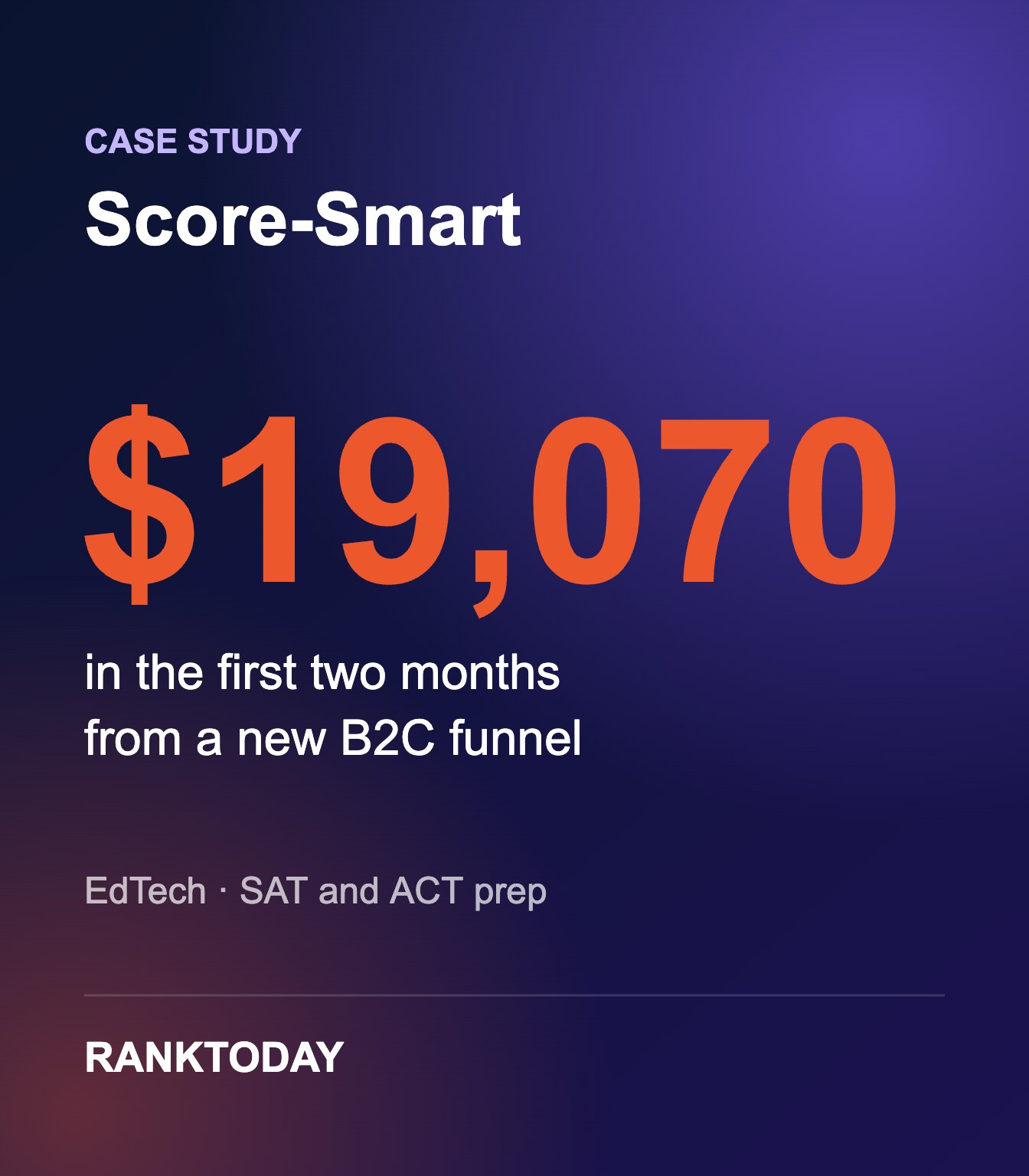
On the content side, for Score Smart, the SAT prep platform we run growth for, a test-prep article we published ranked first on Google and was cited in a Google AI Overview in June 2026, which you can read about in our Score Smart case study. On the paid side, for 108 Performance, a sports coaching brand, the Meta cost per seminar lead fell from $7.60 in the first week of October 2026 to $4.07 for October 30 to November 3, 2026, which shows how quickly ad results can be measured and improved week to week.
A simple way to combine them is to put ad budget behind your best content, retarget people who read your guides, and use the search terms that convert in ads as the topics for your next articles.
Which one should you start with?
If you need sales this month, have a clear offer and can measure leads, start with advertising, because it gives you customers and data straight away. If you sell something people research before buying, such as a service, a high-ticket product or anything in health, finance or education, start content early, because those buyers read several pages before they contact anyone and the content keeps working after launch. For clinics, our guide to healthcare marketing on a small budget shows how to split limited spend between the two.
For most small businesses we suggest running a modest search ad budget on the searches that show buying intent, while publishing one or two genuinely useful articles a month on the questions customers ask, and then shifting budget toward whichever channel brings leads at the lower cost. You can read more about what each channel does in our post on marketing vs branding vs advertising and in how content marketing helps a business.
Questions we get asked
Is content marketing a type of advertising?
No, because content marketing does not pay for placement, and people choose to find and read it. Content often gets promoted with ads, though, and at that point the promotion is advertising even if the thing being promoted is a helpful article.
Is sponsored content content marketing or advertising?
Sponsored content is advertising, since a brand pays a publisher or creator to run it, and in the US the FTC expects it to be clearly labeled as an ad. It borrows the format of content marketing, which is why people confuse the two.
Which is cheaper, content marketing or advertising?
Advertising is cheaper to start and more expensive to keep going, since every click has a price for as long as you run it. Content costs more effort upfront, but a page that ranks keeps bringing visitors without a per-click cost, so over a year or two good content usually brings in leads more cheaply.
What is the difference between content marketing and traditional advertising?
The main difference between content marketing and traditional advertising is that traditional advertising, such as TV, radio, print and billboards, puts a paid message in front of a broad audience, while content marketing waits to be found by people who are already looking for an answer. Traditional ads reach many people quickly, but they are harder to measure and stop when the spending stops.
Is social media content marketing or advertising?
Social media is content marketing when you publish posts, videos and stories to your own followers without paying, and it becomes advertising the moment you pay to boost a post or run ads to people who do not follow you. Most brands use both on the same platform, with organic posts building trust and paid ads widening reach.
Is SEO content marketing or advertising?
SEO belongs on the content marketing side, because it earns unpaid visits by making useful pages easy for search engines to find and rank, and nobody can pay Google for a higher organic position. The paid search ads that appear above or below those results are advertising, even when they point to the same page.
A page built to rank for one search and turn that visitor into a lead is what we call an SEO landing page, and it sits right where content and search meet.
Is marketing the same as advertising?
Advertising is one part of marketing, the paid part where you buy space for a message, while marketing covers everything a business does to reach and win customers, including research, pricing, content, email, SEO and customer experience. Content marketing and advertising are both branches of marketing, which is why the terms get mixed up so often.
If you want to know whether your site is ready to win traffic from content, our free SEO audit scores it for SEO, speed and AI search in about a minute, and you can see how we run both sides on our SEO services and PPC management pages.
Free SEO audit
Want to know where your site stands?
Get a free score for SEO, speed and AI search, plus your top 3 fixes, in about a minute.
Keep reading

Search Engine Marketing
What Are the 4Ps of Healthcare Marketing?
The 4Ps of healthcare marketing are product, price, place and promotion. Here is what each means for a clinic, with…
7 min read

Marketing
What Is an Organic Marketing Strategy and How Do You Build One?
What organic marketing is, how it compares with paid ads, and the six steps we use to build an organic…
8 min read

Marketing
E-commerce Growth Hacking: 22 Strategies to Get More Sales From Your Store
22 e-commerce growth hacking strategies grouped by goal: getting found, converting visitors, raising order value and bringing customers back, with…
8 min read